
The Odour Question: Does Aluminium-Free Deodorant Need Fragrance?
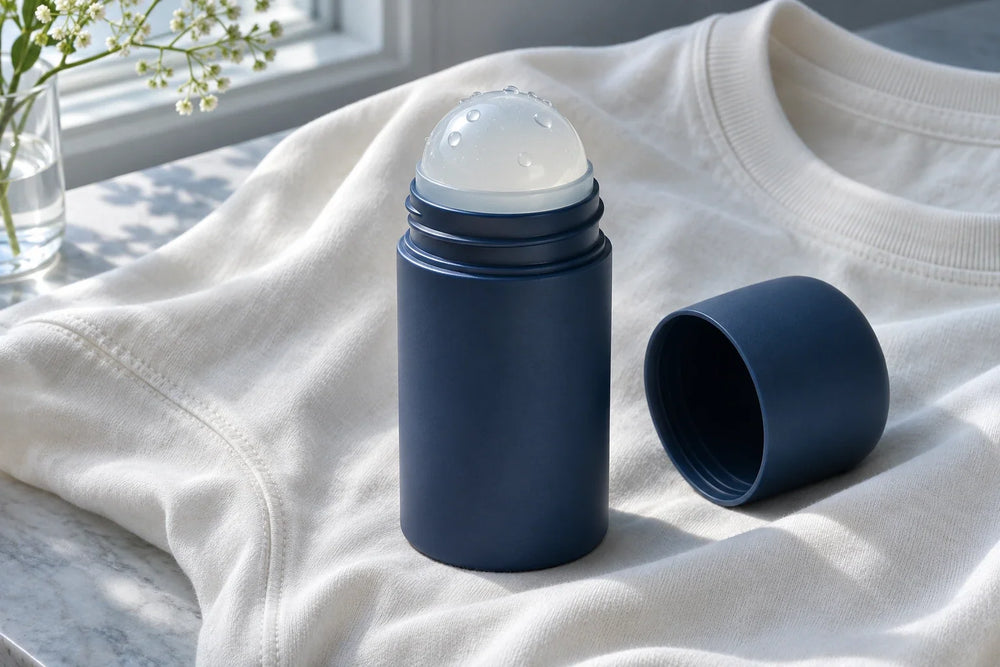
A shower, a clean shirt and a busy day ahead. When body odour appears later, is the answer more deodorant – or a closer look at how your formula works? For sensitive underarms, the distinction matters.
You do not have to stop sweating to tackle body odor. A well-designed deodorant can address odor without aluminum salts or added perfume. What matters is how it works on the skin, not how strongly it smells.
Here is how sweat and odour are connected, how a deodorant differs from an antiperspirant, and what to look for in a roll-on without aluminium salts or added fragrance.

My shirt feels damp. Has my deodorant stopped working?
Tell wetness and odour apart
Notice wetness and odour separately. A deodorant can reduce odour while your underarms still sweat.
THE ESSENTIALS
The key distinction: a deodorant targets body odor; an antiperspirant reduces perspiration. If your priority is staying fresh rather than staying completely dry, deodorant may be exactly the right product category. [1] [2]
Explore SOURCE LAB Deo Sensitiv →
Aluminum-free deodorant: a fresh approach for sensitive skin
Sweat and odour are not the same thing: bacteria on the skin contribute to the formation of body odour. A deodorant without aluminium salts is intended to manage odour, not stop perspiration.
Why sweat does not automatically smell
Sweating is not a hygiene failure. Eccrine sweat glands release a mostly watery fluid that helps the body regulate temperature through evaporation. Fresh sweat usually has very little odor.
Characteristic underarm odor develops largely when bacteria on the skin transform components of sweat and other skin secretions into volatile, odor-active molecules. Apocrine secretions, the underarm microbiome and individual body chemistry all play a role. [1]
A damp shirt does not always come with a strong smell, and the reverse can be true. Before choosing a product, consider whether odour or wetness is what bothers you most.
View the illustration

Aluminum-free deodorant or antiperspirant: what is the difference?
A deodorant is designed to reduce or manage body odor. Depending on its formulation, it may absorb odor molecules, influence odor-producing processes or add a fragrance. An antiperspirant has a different role: aluminum salts temporarily reduce how much sweat reaches the skin surface. [2] [3]
There is no single best choice for everyone. If you want to manage odour while continuing to sweat naturally, a deodorant may suit you. If wetness is the main concern, an antiperspirant has a different purpose.
The useful question is therefore not whether aluminum-free deodorant is 'just as strong' in the abstract. Strong against what—odor or wetness? Once that distinction is clear, the label becomes easier to read.
View the illustration

DEODORANT EXPLAINED
Sweat, odour and fragrance: three different things
Choose a function. Drops, odour particles and a fragrance cloud change independently in the visual.
Schematic cosmetic functions, not a measurement of deodorant performance.
THE KEY DISTINCTION
The goal is fresh confidence, not an overpowering scent.
Managing odour does not necessarily require a strong fragrance. For sensitive underarms, a formula without added perfume may be worth considering, provided it suits your skin.
Sensitive underarm skin: why deodorant can sting
Underarm skin has a demanding daily routine. Shaving removes hair but can also leave the surface more reactive; clothing rubs against the area; sweat and warmth influence how a product feels. Fragrance ingredients are another possible trigger for contact reactions. [5] [6]
If your own roll-on stings when applied, the label check for sensitive underarms can help you choose your next product.
If you avoid fragrance, ‘no added perfume’ tells you more than a vague claim of being natural. Tolerance is individual: let irritated or damaged skin recover before applying a product.
A simpler routine also makes it easier to see what actually agrees with your skin. Our article on overdoing a skincare routine explores the same principle beyond the underarms.
View the illustration

Fragrance-free deodorant: how odor control works without perfume
Yes, deodorant without perfume can work. Fragrance masks or modifies what we smell, but it is not the only method of odor control. Formulators can use substances that bind odor-active compounds rather than cover them with an added scent.
Zinc Ricinoleate is one such cosmetic ingredient. COSMILE Europe lists it for its deodorizing properties; it is used to bind odor-producing substances. It does not act like aluminum salts in antiperspirants. [7]
Performance depends on the entire formulation, how it is applied and the conditions of the day. The important difference is easy to appreciate: a deodorant can pursue effective odor control without relying on a cloud of perfume.
SOURCE LAB Deo Sensitiv: a formula with a clear purpose
This is the approach behind SOURCE LAB Deo Sensitiv. Zinc Ricinoleate is included for odor control, while panthenol complements the formula as a caring ingredient for underarm skin. The brand's carefully balanced mineral blend brings together sodium, calcium, magnesium and strontium.
The 50 ml roll-on contains no added perfume, ethanol or aluminum salts. It is intended to help manage body odor without blocking the natural production of sweat. If you are looking for an aluminum-free deodorant for sensitive skin, those are practical details—not just marketing adjectives.
For readers who enjoy a scent, SOURCE LAB also offers Grapefruit and Bergamot–Sage versions. The fragrance-free Sensitiv version is the more straightforward option when you consciously want to avoid perfume.
SOURCE LAB · MINERAL-BASED CARE
Three considered elements: Zinc Ricinoleate for odor-binding, panthenol for skincare and the SOURCE LAB mineral blend as a common formula base. The point is targeted care rather than unnecessary fragrance.
ODOR CONTROL WITHOUT PERFUME
Care for your underarms. Not another fragrance cloud.
Discover the fragrance-free SOURCE LAB Deo Sensitiv and its ingredient-led approach to everyday odor control.
Explore SOURCE LAB Deo Sensitiv →How to apply roll-on deodorant: four everyday steps
Good application is refreshingly simple. A roll-on does not need a complicated ritual, but clean, dry skin and a little patience can make the routine more pleasant. Avoid applying deodorant to broken or significantly irritated skin.
View the illustration


Still noticing odor? Three details worth checking
What difference does my shirt make?
1. The skin is still damp. Gently pat dry before applying. 2. Too much product is applied. A thin, even layer is usually enough according to product guidance. 3. You actually want sweat reduction. An antiperspirant has a different function from a deodorant.
A sudden major change in sweating or persistent underarm irritation deserves medical advice, rather than repeated attempts to cover it with more product. Everyday odor, however, often calls simply for a formula that fits your needs.
Is aluminum in antiperspirants harmful? What science says
Aluminum salts in antiperspirants have been the subject of alarming claims. Major scientific bodies do not establish a causal link between ordinary antiperspirant use and breast cancer. The US National Cancer Institute and Germany's Federal Institute for Risk Assessment discuss the evidence and its limits. [9] [10]
Choosing deodorant without aluminum can still make perfect sense. You may simply prefer natural perspiration and focused odor control. That is a clear product preference; it does not require making unsupported health claims about other products.
Frequently asked questions about aluminum-free deodorant
Does aluminum-free deodorant actually work against body odor?
Yes. An aluminum-free deodorant can reduce odor using deodorizing ingredients such as Zinc Ricinoleate. Unlike antiperspirants, it is not intended to reduce the amount of sweat.
Can a deodorant without fragrance still keep me fresh?
Yes. Perfume is not essential for odor control. Ingredients can bind odor-active compounds without adding a scent.
Is aluminum-free automatically better for sensitive skin?
Not automatically. Check the full ingredient list and any known sensitivities. A fragrance-free formula can be a useful option if perfume tends to irritate your skin.
What is the difference between deodorant and antiperspirant?
Deodorant targets odor. Antiperspirant temporarily reduces perspiration, generally using aluminum salts.
Why do I still smell after applying deodorant?
Skin bacteria, application, clothing and personal chemistry can all influence odor. Clean, dry skin and a suitable deodorant formula are a good starting point.
Can I use a roll-on directly after shaving?
Freshly shaved skin can be more sensitive. Wait if the skin is irritated, and do not apply deodorant to damaged or open skin.
What does Zinc Ricinoleate do?
It is a deodorizing cosmetic ingredient used to bind odor-active compounds. It is not an antiperspirant aluminum salt.
Scientific background & sources
Expert references explain general skin physiology and cosmetic functions. They are not clinical trials of this specific deodorant. Product composition is based on the current SOURCE LAB product information.
- Cleveland Clinic: Body Odor
- American Academy of Dermatology: Deodorant versus Antitranspirant
- DermNet: Antiperspirants
- Bundesinstitut für Risikobewertung: Deodorants und Antitranspirants
- Musicante, Cohen & Milam (2024): Axillary Contact Dermatitis
- DermNet: Fragrance Allergy
- COSMILE Europe: Zinkricinoleat
- COSMILE Europe: Desodorierende Wirkstoffe
- BfR (2025): Antitranspirants mit Aluminiumsalzen
- National Cancer Institute: Antitranspirants und Brustkrebs
Choosing a fragrance-free deodorant for sensitive underarms
Start with the result you want: deodorant is designed to manage odour, while an antiperspirant is intended to reduce sweat. If staying dry is your priority, the two are not interchangeable.
If you avoid fragrance, check the complete ingredient list rather than relying on the word ‘sensitive’. SOURCE LAB Deo Sensitiv is a roll-on without added perfume; individual tolerance still varies. Do not apply it to broken or significantly irritated skin, and seek medical advice if irritation persists.
See Deo Sensitiv and its ingredients →
SOURCE LAB · SENSITIVE SKIN
LESS PERFUME. MORE PURPOSEFUL ODOR CONTROL.
You want a deodorant that does its job—not one that simply covers everything with fragrance. SOURCE LAB Deo Sensitiv combines Zinc Ricinoleate, panthenol and the carefully balanced mineral blend, without added perfume, ethanol or aluminum salts.
Discover SOURCE LAB Deo Sensitiv →More from the SOURCE LAB Magazine
If you'd like to explore this topic further, these guides offer practical perspectives on your skincare routine.
 One Skin, Four Worlds: Why Skincare Can’t Work the Same EverywhereFace, scalp and underarms have different needs. Learn why the best skincare routine can vary across the body.
 Why Does Your Skin Feel Tight After Washing? Is It Your Soap?Soap is alkaline, but healthy skin is mildly acidic. Learn what this means for dry skin, why pH is only part of the story, and how to choose a gentler cleansing routine.
 Overdoing Skincare: 7 Signs Your Skin Needs a Simpler RoutineCan you use too much skincare? Learn seven signs that your routine may be overwhelming your skin and how gentle barrier care can help.
 Sunscreen, Sweat, Air Conditioning: Why Your Skin Plays by Different Rules in SummerSensitive skin in summer: a simple routine for sunscreen, heat, sweat and indoor air conditioning.
 THE MAGAZINEExplore the SOURCE LAB MagazineMore guides to skin, ingredients and daily skincare routines.Visit the magazine
 BY THE WAYGet to know SOURCE LABDiscover our mineral skincare and the idea behind the brand.Visit homepage
Tried these yet?


