Dry cheeks, spots on your chin: Why both can happen
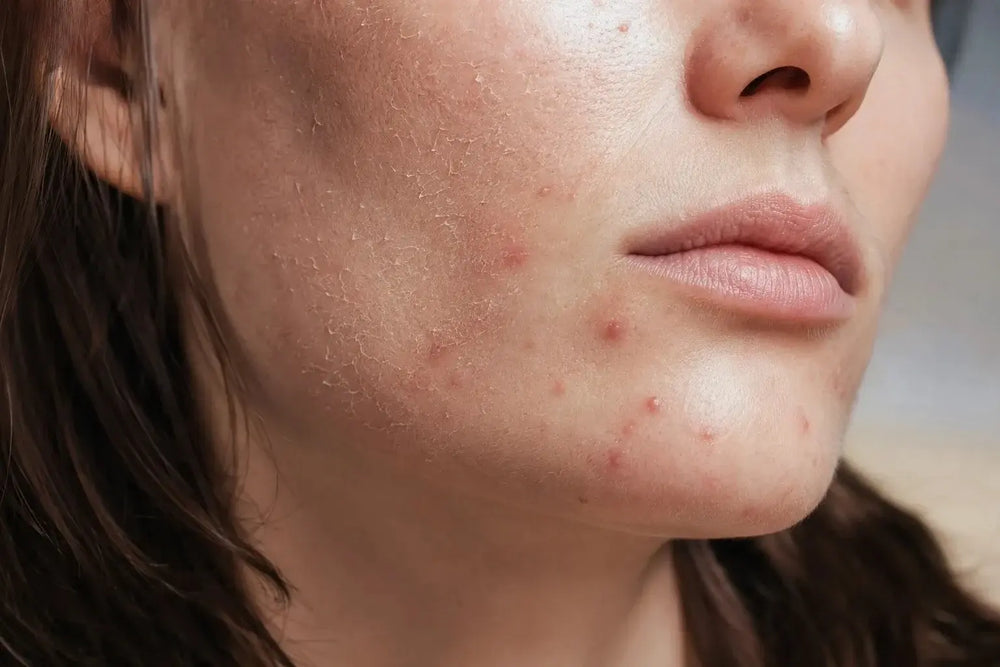
Your cheeks feel tight. The skin around your nose starts to flake. And yet another spot appears on your chin. Reach for a strong anti-blemish product and everything feels drier; choose a richer cream and you wonder if you are inviting more breakouts.
You should not have to choose between caring for dryness and taking blemishes seriously.
The first step is to separate the questions: what does the dry skin need, what is happening in the pores, and which parts of your routine are actually helping?
THE SHORT ANSWER
Yes: dry skin and pimples can exist at the same time. Water in the outer skin layer, barrier function and activity inside oil-producing follicles are different things. Blemish-prone skin can still benefit from suitable moisturising care. [1], [3], [4]
Not every red bump is acne, however. Persistent rashes, painful nodules or worsening symptoms should be assessed by a dermatologist.
Why can dry skin still develop pimples?
A spot does not form simply because your face feels oily. Acne involves sebum, cells building up inside the follicle and inflammation, among other factors. Hormones can influence oil glands. None of this tells us whether the outer layer of skin is retaining enough water. [1], [2]
Dryness concerns the surface and how skin feels
Rough patches, flaking and tightness may indicate a dry skin state. Cleansing, weather and the products you use can all affect comfort. [3]
Blemishes develop around the pores
Blackheads and inflamed spots form in follicles connected to oil glands. They cannot be explained solely by how hydrated your face feels. [1]
Researchers have also studied this combination. One small trial involving 29 adult women with mild acne and dry, sensitive skin examined a gentle cleanser alongside two moisturising products. Its findings apply to that particular combination—not to all creams and not to SOURCE LAB products. The study illustrates why supportive skincare in blemish-prone skin deserves attention. [9]
 Dryness and blemishes describe different aspects of the skin. This is a schematic guide, not a diagnostic test.
What might be making both concerns more noticeable?
There does not need to be a single cause. Your skin may have been prone to spots for years, while a new acne treatment leaves it drier. Or indoor heating makes flaky cheeks more noticeable while the occasional chin breakout continues.
Cleansing that strips too much
Frequent washing, hot water and vigorous rubbing can further irritate dry or sensitive skin. A squeaky-clean feeling does not prove that breakouts will improve. [3], [6]
Dryness from acne treatments
Benzoyl peroxide, salicylic acid and certain retinoids can cause dryness or irritation. An appropriate moisturiser may help alongside treatment. Never change prescribed medication on your own. [4]
Too many new products at once
A new exfoliant, a different serum and another moisturiser make it difficult to tell what your skin is responding to. Frequent changes may add irritation. [6]
If your routine keeps growing while your skin feels increasingly reactive, read our guide to over-treated skin and an overloaded routine.
 Look at the whole routine. Discuss irritation from prescribed acne treatments with your doctor.
AN IMPORTANT DISTINCTION
One pimple does not make your whole face a problem area.
Dry cheeks do not necessarily need the same extra cosmetic care as one blemish on the chin. Everyday moisturising care and an optional spot product can serve different purposes. Prescription acne medicines, however, must always be used as directed.
Which moisturiser suits dry, blemish-prone skin?
The choice is not simply between a very rich cream and no moisturiser at all. The formula needs to feel comfortable on dry skin while also suiting skin prone to blemishes. Dermatology guidance often recommends looking for non-comedogenic products—formulas intended not to clog pores. [4], [5]
That label is not a guarantee for everyone. Pay attention to how your skin responds to the finished product. You cannot predict the tolerance of a complete formula from just one oil or ingredient on the list. [7]
The relationship between barrier care and blemishes is also reflected in a study comparing 36 people with acne and 29 control participants. Researchers investigated the skin-water barrier and components of surface lipids. This helps describe an association; it is not proof that any particular cosmetic product works. [10]
If dryness remains your main concern even after applying cream, explore why skin can stay dry despite moisturising.
 Humectants and lipids have different purposes. One well-formulated moisturiser can combine both.
A straightforward routine that respects both needs
You do not have to replace everything overnight. Keep the basics that already agree with your skin and decide which additional step, if any, has a clear purpose.
Cleanse gently
A mild, non-abrasive cleanser and your fingertips are usually a better starting point than brushes or vigorous scrubbing. The NICE acne guideline recommends a non-alkaline cleansing product. [5], [6]
Moisturise dry areas appropriately
Breakouts are not a reason to abandon moisturiser. Match the amount and texture to how your skin feels and follow product directions. [4], [7]
Keep extra spot care targeted
A cosmetic spot product may be intended for individual blemishes. It is not the same as prescription acne treatment, which may need application to a wider affected area.
Do not forget daytime sun protection
Outdoors, combine shade and protective clothing with suitable broad-spectrum SPF 30 or higher. Some acne treatments can increase sensitivity to sunlight. [6]
These are skincare functions, not a fixed order for every formula. Always follow individual product instructions and any medical treatment plan.
 A simple foundation comes first; optional cosmetic spot care does not replace sun protection or acne treatment.
How SOURCE LAB separates the different skincare jobs
For dry, sensitive skin with occasional blemishes, the SOURCE LAB Skin Balance Set brings together three products with different purposes. They share our exclusive mineral complex with sodium, calcium, magnesium and strontium.
LIGHTWEIGHT MOISTURE
Mineral Skin Spray
This fragrance-free water-based product combines the mineral mix with pentylene glycol. A lightweight option when your skin feels dry or tight and you enjoy a spray texture.
MOISTURE & EMOLLIENT CARE
Sensitive Skin Cream
Glycerin, Ceramide NP, squalane and shea butter complement the mineral base. The cream is designed to care for dry, rough or tight-feeling skin.
TARGETED, WHEN NEEDED
Mineral Roll-On
Zinc PCA, ectoin and the mineral mix are combined for individual blemishes. According to its directions, apply only to cleaned, dry areas—not across the whole face.
You do not automatically need the complete set. If your existing moisturiser works for you, keep it. A separate lightweight step is an option, not a requirement. Use any spot product only where its instructions recommend.
COSMETIC CARE, NOT ACNE TREATMENT
These products are for cosmetic care. They do not replace diagnosis or prescribed treatment. The claim “non-comedogenic” cannot be inferred from the ingredient list alone.
Want to see how the steps fit together? Visit our page on skincare for dry skin with blemishes.
What to watch for—without constantly switching products
Notice which areas feel dry, when tightness appears and when new blemishes began. Write down products you have recently introduced. These notes do not prove a cause, but they help you spot patterns.
Watch dryness and blemishes separately. A cream can improve comfort without treating the cause of acne. Likewise, effective acne medication can make supportive moisturising care especially relevant. [4]
Your skincare routine should not be guesswork.
Our free 14-day Skin Compass offers short observation exercises, a skin map and a routine planner. Record how your skin feels and make more informed choices about the steps you actually need.
Understand my routine with the free Skin Compass →No registration. A self-observation tool, not a medical test or a promise of results in 14 days.
When dry skin and pimples need a dermatologist
Deep painful lumps, scarring or persistent symptoms may require more than a different moisturiser. If your skin is affecting your wellbeing, seek professional dermatology advice. [5], [7]
Small inflamed bumps and flaking around the mouth, nose or eyes may suggest perioral dermatitis rather than ordinary spots. Do not self-diagnose or change prescribed steroid medication without speaking to your doctor. [8]
Frequently asked questions about dry skin and pimples
Can dry skin really get pimples?
Is my skin dry or just dehydrated?
Should I skip moisturiser if I get spots?
Does a new spot mean my cream is too rich?
Should I exfoliate dry, flaky patches more?
Flaking is not an instruction to scrub harder. Frequent exfoliation and rubbing can worsen irritation. Discuss unwanted effects of prescribed treatment with your clinician. [6]
Can I use spot care on individual pimples?
Yes, if the cosmetic product is designed for local use, such as the SOURCE LAB Mineral Roll-On. Prescription acne medication may have different directions and coverage areas.
Scientific context & sources
This article discusses cosmetic skincare and distinguishes it from medical acne treatment. The research cited below is not evidence of effectiveness for SOURCE LAB products. Product details come from the linked official product pages.
- NIAMS: Acne
- American Academy of Dermatology: Acne – causes
- American Academy of Dermatology: Dry skin care
- American Academy of Dermatology: Acne moisturiser
- NICE NG198: Acne vulgaris – Recommendations
- American Academy of Dermatology: Acne skin care tips
- MedlinePlus: Acne – self-care
- American Academy of Dermatology: Perioral dermatitis
- Isoda et al. (2015): study of cleansing and moisturising in 29 women with mild acne and sensitive, dry skin
- Yamamoto et al. (1995): Impaired water barrier function in acne vulgaris; 36 acne patients and 29 controls
More to explore in the SOURCE LAB Magazine
DRY SKIN
Why skin stays dry despite cream
What cleansing, moisture and the skin barrier have to do with it.
OVER-TREATED SKIN
When your routine becomes too much
Seven possible signs and a clearer look at your skincare steps.
MINERALS
Calcium and the skin barrier
What skin biology tells us—and what a finished formula must prove.
ECTOIN
An ingredient in scientific context
Looking beyond sweeping promises about a single active ingredient.
CARING FOR DRYNESS AND BLEMISHES TOGETHER
Everyday care for your skin. Targeted care only where needed.
Explore how Mineral Skin Spray, Sensitive Skin Cream and Mineral Roll-On can serve different roles in the Skin Balance Set—and decide which fit your existing routine.
Explore the Skin Balance Set & directions →Eligible skincare bought directly from SOURCE LAB can be tried under our 30-day satisfaction guarantee—including products opened and reasonably tried, subject to the conditions.


Have you tried it yet?


