When Skincare Becomes a Layering Ritual: What Skin Flooding Really Does
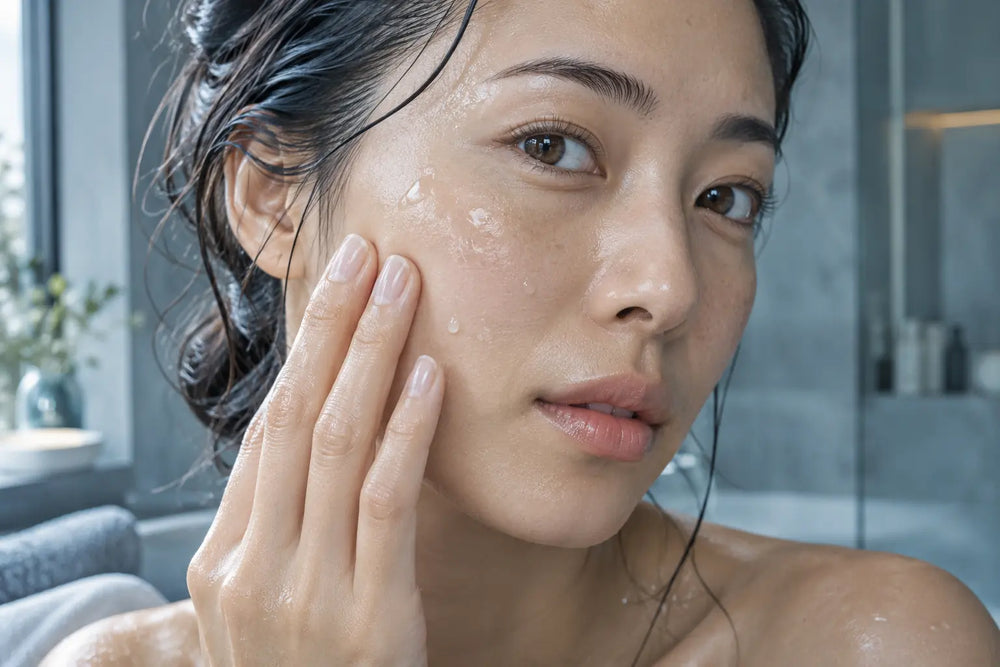
First comes a fine mist. Then toner. Essence. Serum. Perhaps another serum. Cream. Oil on top.
Skin Flooding has turned a fairly simple skincare idea into a ritual in which hydration is supposed to become visible layer by layer.
The result looks impressive on a phone screen: plump, smooth, highly reflective skin that seems almost glass-like.
But visible shine is not a hydration meter. And seven products do not automatically do seven times more than two.
Skin Flooding is built around a sensible principle: apply lightweight water-based skincare to slightly damp skin, then add a richer texture if the skin needs it.
That does not require seven fixed layers or an entire collection of near-identical serums.
How hydration became a seven-step routine
Skin Flooding initially describes an application technique: several mostly hydrating textures are applied one after another, often before the previous layer has fully dried.
The social-media version often looks something like this:
Mist or toner
A lightweight water-based start.
Essence
Another light skincare layer.
Serum
Often built around humectant ingredients.
Another serum
Quite often doing a very similar job.
Cream
Adds richer care to the lighter textures.
Oil
May be used as a more occlusive finishing layer.
What easily gets lost is that Skin Flooding is not a medically defined technique and does not prescribe a fixed number of products.
The technique describes an order of textures — not a shopping list.

More layers are not the same as more hydration
Toner, essence and three similar hydrating serums may give you five products — while still repeating essentially the same skincare task five times.
Your skin does not care how many bottles were opened. What matters is what the complete routine actually does.
A simple routine with one lightweight water-based step and an appropriate moisturiser can already reproduce the central principle of Skin Flooding.
If your routine also contains acids, retinoids or other active products, separating those steps may make more sense than adding even more layers. That is the idea behind Your Skin Doesn’t Know the Calendar: What Makes Skin Cycling Actually Useful.
Why apply skincare to slightly damp skin?
After cleansing, some water remains on the surface of the skin. This is where the more useful part of the trend begins.
Applying an appropriate skincare product at this point can help bind water at the surface or reduce subsequent water loss, depending on the formulation.
The face does not need to be dripping wet.
The version without seven bottles
1. Cleanse gently
2. Pat away excess water
3. Apply one lightweight water-based step
4. Let it spread or settle briefly
5. Add moisturiser only where the skin needs it
Slightly damp is enough. “Flooding” does not need to be taken literally.
Hydration is not the same as richness
Social media often blends hydration, moisture, barrier repair and glow into one big promise. In a formula, however, different ingredient groups perform different jobs.
Humectants
Water-loving ingredients such as glycerin or hyaluronic acid that can bind water and support hydration in the upper layers of skin.
Emollients
Softening ingredients that can make the skin surface feel smoother and more supple.
Occlusives
More film-forming components that can help reduce water loss from the skin surface.
A well-designed moisturiser can perform several of these jobs at once. Not every function needs a separate bottle.
Glass Skin is a look — not a laboratory measurement
Skin Flooding is closely connected with another beauty ideal: Glass Skin.
The term describes skin that appears exceptionally even, smooth, hydrated and luminous.
In short-form videos, however, skincare and visual staging quickly start to blur together.
Several damp or oily textures create immediate reflections. Add make-up, lighting, camera angles and possibly editing, and the effect becomes even stronger.
Shiny skin is not automatically exceptionally well-hydrated skin.
Visible shine may come from products that have not fully absorbed, sebum, oil, make-up or simply the lighting.
Glow can look beautiful. It is not an objective measurement of skin condition.

The better glow test does not happen in front of a camera
More interesting than how strongly skin reflects light is how it behaves a few hours later.
Skin comfort is a better measure of skincare than a filter-like finish.
When layering turns into product traffic
Several lightweight textures are not inherently a problem. Some skin may genuinely enjoy the feeling.
But every additional layer also adds another formula, preservative system, potential fragrance and possibly more active ingredients.
For sensitive skin in particular, that can make the routine increasingly difficult to understand.
Everything feels sticky
Several gel-like textures can leave a noticeable film.
Products start to pill
Too many overlapping formulas can form small rolls on the skin.
Sunscreen becomes harder to apply
The final and most important morning step still needs to spread evenly.
Reactions become harder to trace
With six new products at once, it becomes very difficult to identify which one your skin dislikes.
Your sunscreen may not be the problem
Mist, serum, another serum, cream — everything feels beautifully moisturised. Then sunscreen goes on and small rolls suddenly appear.
Before replacing the sunscreen, try a simpler morning: one lightweight water-based step, moisturiser only where needed, allow it to settle briefly, then apply sunscreen.
If everything works much better, the problem may not have been too little skincare — but too much underneath.
Sensitive skin does not need seven new unknowns
The basic idea can absolutely be useful for skin that feels dry or tight.
Sensitive skin, however, often benefits from a routine that remains easy to understand.
Instead of introducing seven new products at once, Skin Flooding can be reduced to a few clearly defined steps.
Cleanse gently
Remove make-up, sunscreen and residue without unnecessarily stripping the skin.
Lightweight water-based step
Apply to slightly damp skin and allow it to distribute briefly.
Moisturiser according to skin feel
Add it where skin feels dry or tight.
The SOURCE LAB Mineral Skin Spray can take the role of the lightweight water-based first step.
The Sensitive Skin Cream can then add Ceramide NP, squalane, glycerin and shea butter where richer care is needed.
To understand why a face mist can be more than a quick refresh, read Why We Spray Skincare on Our Faces — and When a Face Mist Actually Makes Sense.
If your skin stays dry despite moisturiser, also see You Moisturise. Your Skin Still Feels Dry. The Problem May Start Somewhere Else.
Sensitive Skin Cream: rated “very good” by Dermatest
The cream was patch-tested under dermatological supervision on 30 people with sensitive skin. No relevant skin reactions occurred in the test area after a single application.
The result relates to the tested product and study design and does not guarantee individual tolerance.

Two steps can carry the same basic idea
The core of Skin Flooding is not “use as many hydrating products as possible”.
It is: begin with something light, add hydration in a sensible way and use only as much richer care as the skin actually needs.
Evening
1. Gentle cleansing
2. Mineral Skin Spray
3. Sensitive Skin Cream as needed
Morning
1. Gentle cleanse or refresh
2. Mineral Skin Spray
3. Moisturiser as needed
4. Appropriate sunscreen
The trend does not become better just because the routine becomes longer.
How much product does skin actually need?
Skin Flooding can encourage not only more layers, but larger amounts of every layer.
That is rarely necessary.
A facial spray needs only a fine, even mist. With cream, start small and add more only to areas that feel dry.
If the skin becomes slippery, very sticky or the products seem to float on top of one another, that is not proof of exceptional hydration — it may simply be too much product.
Who might still benefit from the idea?
A reduced form of Skin Flooding may be useful when skin feels dry, rough or tight, or when very rich single products do not feel comfortable.
Combination skin can also use the principle selectively: more cream where skin is dry, less where it does not need it.
Visible oiliness tells you little about water content. An oily T-zone and dry-feeling cheeks can easily exist at the same time.
Severely inflamed, painful or persistent skin changes should not be managed through cosmetic experimentation alone.
Scientific context & sources
Skin Flooding is a trend term rather than a medical treatment. The scientific context in this article is therefore based on established evidence around the skin barrier, humectants, emollients, occlusive ingredients and the application of moisturiser to slightly damp skin.
Common questions about Skin Flooding
What is Skin Flooding?
Skin Flooding is a layering technique in which lightweight water-based skincare is applied to slightly damp skin and followed with richer care if needed.
Do I need several serums?
No. Several products performing a similar task are not automatically necessary. One lightweight water-based step and a suitable moisturiser may already be enough.
Do I need hyaluronic acid for Skin Flooding?
No. Skin Flooding is not tied to one particular ingredient. The function of the formulas matters more.
Should skin still be damp before moisturiser?
It can be slightly damp. It does not need to be soaking wet. The moisturiser should still spread evenly.
Is Skin Flooding suitable for sensitive skin?
A reduced version using a few familiar, well-tolerated products can make sense. Introducing many new formulas at once makes reactions harder to understand.
Can Skin Flooding replace sunscreen?
No. A facial mist, serum or moisturiser without a stated SPF does not replace appropriate sun protection.
You cannot measure good hydration by counting layers
Skin Flooding starts from a useful idea: lightweight skincare on slightly damp skin, followed by only as much richer care as necessary.
Turning that into seven steps is one interpretation of the trend — not a requirement for it to work.
Sensitive skin in particular may benefit when every layer has a clear purpose and similar products are not simply stacked indefinitely.
More glow does not automatically require more products. Sometimes skin simply needs a better sequence.

Lightweight care first. Moisturiser only when your skin needs it.
Mineral Skin Spray and Sensitive Skin Cream form a straightforward two-step routine with the SOURCE LAB Mineral Mix.
Fewer layers, clearer roles — try the routine at your own pace with our 30-day satisfaction guarantee.
EXPLORE THE SIMPLIFIED ROUTINEFrom reading to your own skincare routine
Would you like to observe your skin and routine more closely? The free 14-day Hautkompass helps you record how your skin feels, your skincare steps and any changes. With short exercises, a digital skin map and worksheets to fill in — no registration or purchase required.
More Articles


Have you tried it yet?


